01 / ManufacturingFlow · Product case study
From a floor event
to a clear next action.
Material requests, inventory, waste, and maintenance are parts of the same operation. ManufacturingFlow brings those workflows into one shared system.
Request ManufacturingFlow Demo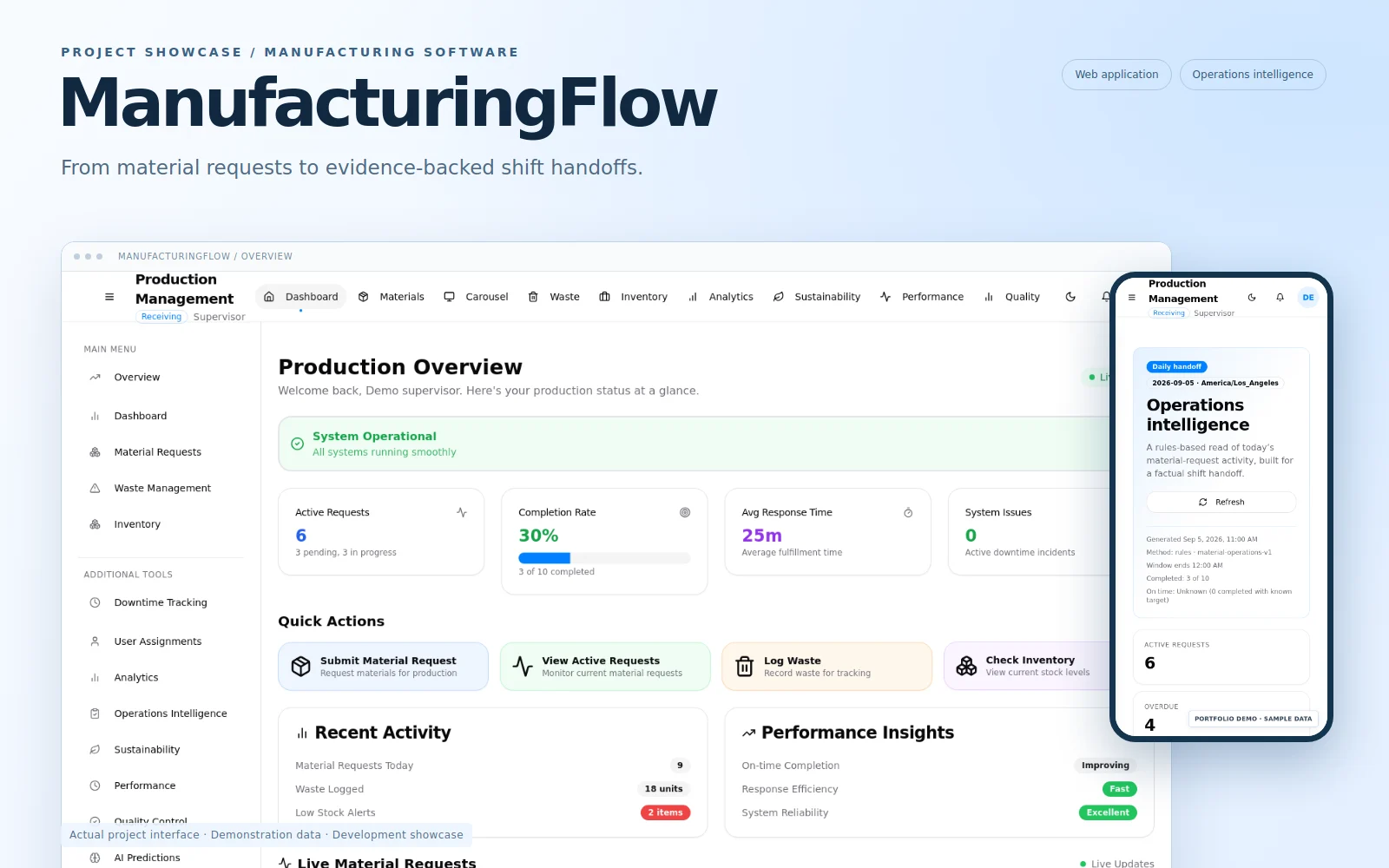
The starting point
Work keeps moving.
Information gets left behind.
A line needs materials. A handler is already on another job. A machine stops. Someone records waste later, away from the point where it happened.
When those events travel through separate conversations, the team loses a shared picture of priority, ownership, and state. ManufacturingFlow starts with that physical workflow.
“Who’s handling this?”
- Requests travel through calls and handoffs.
- Priority and ownership are difficult to see.
- Operational events become scattered records.
A shared operational record.
- Capture the need where it occurs.
- Make priority, state and assignment visible.
- Keep the event connected to its outcome.
How the workflow connects
The request has a journey.
- 01
Capture
A worker identifies a material need and records the request.
- 02
Prioritize
Department, material and priority give the request its context.
- 03
Assign
A handler takes responsibility for fulfillment.
- 04
Update
Pending becomes in progress, completed, or canceled.
- 05
Measure
Request records support visibility into fulfillment and response time.
High: up to 30 minutes. Medium: 30–90 minutes. Low: 90–150 minutes. These are the supplied product’s planning targets, not a service guarantee.
One operational picture. Built around the people doing the work.
Read the case studyArchitecture with a purpose
Capture once.
Keep the operation informed.
PostgreSQL + Drizzle
Store operational records and make their structure explicit.
SSE + WebSockets
Carry operational event updates to the people viewing the system.
Redis
Support fast access to frequently used state.
Session-backed authentication
Keep access tied to an authenticated user and their role.
Python + scikit-learn
Support response-time and assignment prediction work. Predictions require evaluation against actual operating data.
PDF + Excel exports
Move operational information into review, reporting and offline workflows.
What needs to be measured
Better visibility is the start.
The operation is the test.
Evaluate the system against a baseline from the actual operation. Focus on where time is lost, whether work is fulfilled, and whether records explain what happened.
This case study describes the supplied product scope and design rationale. It does not present verified customer outcomes, audited uptime, or measured savings. Machine learning performance and deployment readiness need validation against the active product. This workflow software does not replace machine guarding, lockout/tagout, emergency response, or required environmental records. Any recommendations affecting workers need qualified human review.
Explore the illustrative labor calculator